Multimodal Interpretation
Hao Feng Lv3

As machine learning models penetrate critical areas like medicine, the criminal justice system, and financial markets, the inability of humans to understand these models seems problematic. [1]

Interpretable Machine Learning

Open ATA里的可解释性总结

  • Interpretability must be qualified. To be meaningful, any assertion regarding interpretability should fix a specific definition.
  • Transparency may be at odds with the broader objectives of AI.
  • 全局模型无关解释方法(Global Model-Agnostic)& 局部模型无关解释方法(Local Model-Agnostic)

Shapley Value

在合作博弈论中,是一种在合作的一组玩家之间公平分配总收益或成本的方法。例如,在每个成员贡献不同的团队项目中,Shapley Value提供了一种方法来确定每个成员应得到多少赞誉或责备。

例子:假设一个简化的企业生产环境,所有者提供了关键的资本,因为没有他/她,就无法获得任何收益。有个工人 ,每个工人都为总利润贡献了金额

我们则有公司员工集合

假设价值函数:

我们可以根据Shapley Value计算公式得到不同人的贡献:

Shapley Value计算公式

Game Theory for Economic Analysis. [1]

  1. 子集组合排序
  2. R的全排序

在第位上。

(示例)计算所有者贡献

则有

SHAP-一种局部模型无关的可解释性方法

A Unified Approach to Interpreting Model Predictions [2]

https://shap.readthedocs.io/en/latest/

这里只提及了加权线性回归来近似计算(Kernel SHAP),还有深度学习网络 (Deep SHAP)

一种用于解释任何机器学习模型输出的博弈论方法。它利用博弈论中的经典 Shapley 值及其相关扩展,将最优信用分配(optimal credit allocation)与局部解释联系起来,即归因值。

归因值之和+基准值应该为预测值

**加性特征归因**三个特性

多个特征(或变量)的总贡献被认为是它们单独贡献的总和。

  • 局部准确性 (Local Accuracy)
    • 解释模型在简化输入 x′ 对应原始输入 x 时,至少匹配原始模型 f 的输出
    • 所有特征的归因之和,精确等于模型输出与基线(背景分布均值)的差值。
  • 可缺失性 (Missingness)
    • 对于任何在所有上下文下都不改变模型输出的特征,必须
    • 即,如果模型并未“用到”这个特征,它就不应分到任何贡献。
  • 一致性 (Consistency)
    • 若在另一个模型中,对每一种上下文 ,若有,则应有

大部分方法,例如LIME、DeepLIFT只满足其中一两个特性,而传统Shaley Value估计方法能同时满足这三个特性。

  1. 归因值 φᵢ:确实是把特征 i 在所有可能的子集 S 中“加入”时对模型预测的边际提升累计起来。
  2. 模型预测:SHAP 中用的 v(S) 就是“在保留特征子集 S 值不变、其他特征随机化”下的条件期望。根据一个基准值来计算。

  1. 加权平均
    • 每个边际贡献项

- 权重

在实际计算时,为了估计那个条件期望,往往会用背景样本做 Monte Carlo 近似,或者针对决策树用专门的 Tree SHAP 算法做精确计算。

Examples

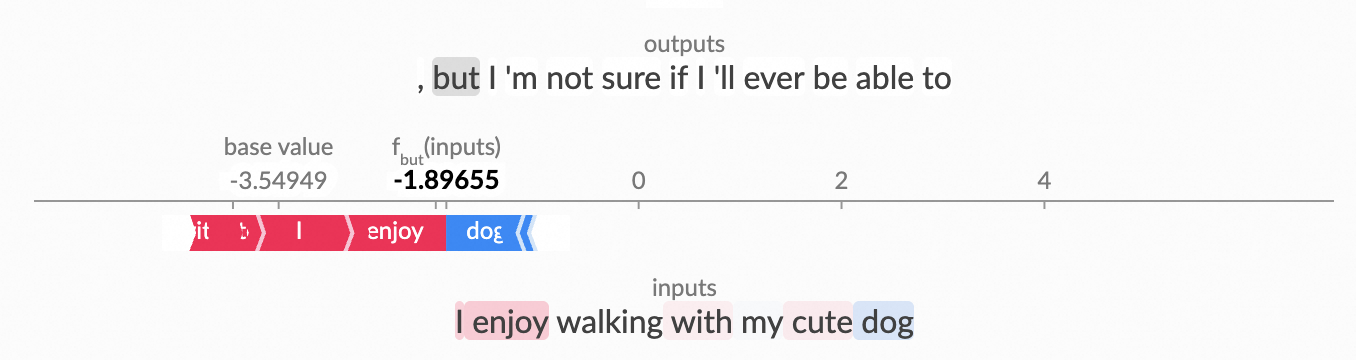
Text
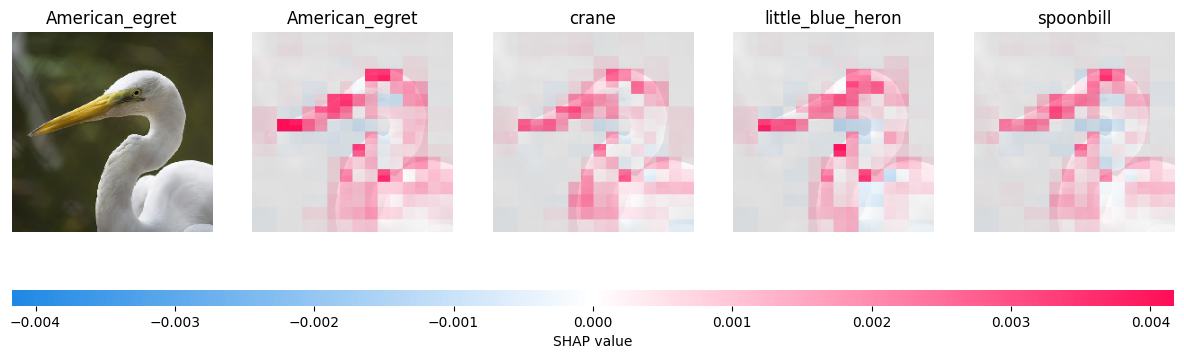
Image

import json

import numpy as np
import torch
import torchvision

import shap

device = torch.device("cuda:0" if torch.cuda.is_available() else "cpu")

model = torchvision.models.mobilenet_v2(pretrained=True, progress=False)
model.to(device)
model.eval()
X, y = shap.datasets.imagenet50()

# Getting ImageNet 1000 class names
url = "https://s3.amazonaws.com/deep-learning-models/image-models/imagenet_class_index.json"
with open(shap.datasets.cache(url)) as file:
class_names = [v[1] for v in json.load(file).values()]
print("Number of ImageNet classes:", len(class_names))
# print("Class names:", class_names)

# Prepare data transformation pipeline

mean = [0.485, 0.456, 0.406]
std = [0.229, 0.224, 0.225]


def nhwc_to_nchw(x: torch.Tensor) -> torch.Tensor:
if x.dim() == 4:
x = x if x.shape[1] == 3 else x.permute(0, 3, 1, 2)
elif x.dim() == 3:
x = x if x.shape[0] == 3 else x.permute(2, 0, 1)
return x


def nchw_to_nhwc(x: torch.Tensor) -> torch.Tensor:
if x.dim() == 4:
x = x if x.shape[3] == 3 else x.permute(0, 2, 3, 1)
elif x.dim() == 3:
x = x if x.shape[2] == 3 else x.permute(1, 2, 0)
return x


transform = [
torchvision.transforms.Lambda(nhwc_to_nchw),
torchvision.transforms.Lambda(lambda x: x * (1 / 255)),
torchvision.transforms.Normalize(mean=mean, std=std),
torchvision.transforms.Lambda(nchw_to_nhwc),
]

inv_transform = [
torchvision.transforms.Lambda(nhwc_to_nchw),
torchvision.transforms.Normalize(
mean=(-1 * np.array(mean) / np.array(std)).tolist(),
std=(1 / np.array(std)).tolist(),
),
torchvision.transforms.Lambda(nchw_to_nhwc),
]

transform = torchvision.transforms.Compose(transform)
inv_transform = torchvision.transforms.Compose(inv_transform)

def predict(img: np.ndarray) -> torch.Tensor:
img = nhwc_to_nchw(torch.Tensor(img))
img = img.to(device)
output = model(img)
return output

# Check that transformations work correctly
Xtr = transform(torch.Tensor(X))
out = predict(Xtr[1:3])
classes = torch.argmax(out, axis=1).cpu().numpy()
print(f"Classes: {classes}: {np.array(class_names)[classes]}")

topk = 4
batch_size = 50
n_evals = 10000

# define a masker that is used to mask out partitions of the input image.
masker_blur = shap.maskers.Image("blur(128,128)", Xtr[0].shape)

# create an explainer with model and image masker
explainer = shap.Explainer(predict, masker_blur, output_names=class_names)

# feed only one image
# here we explain two images using 100 evaluations of the underlying model to estimate the SHAP values
shap_values = explainer(
Xtr[1:2],
max_evals=n_evals,
batch_size=batch_size,
outputs=shap.Explanation.argsort.flip[:topk],
)

(shap_values.data.shape, shap_values.values.shape)

shap_values.data = inv_transform(shap_values.data).cpu().numpy()[0]
shap_values.values = [val for val in np.moveaxis(shap_values.values[0], -1, 0)]

shap.image_plot(
shap_values=shap_values.values,
pixel_values=shap_values.data,
labels=shap_values.output_names,
true_labels=[class_names[132]],
)

SHAP for MultiModal

刚刚的单模态SHAP里面有另外两个比较重要的特性

  • 权重值和应为1

  • 归因值之和+基准值应该为预测值

多模态与单模态的区别

单模态只处理单一类型的数据,如

  • 文本(Text)
  • 图像(Image)
  • 语音(Audio)
  • 结构化特征(Tabular)

而多模态同时处理**多种类型**的数据,比如:

  • 图像 + 文本(如:图文检索、图像字幕生成)
  • 语音 + 视频(如:视频理解、虚拟主播)
  • 传感器信号 + 时间序列(如:多传感器融合的智能驾驶)

多模态模型架构与融合策略

  • 早期融合(Early Fusion)
    • 在最底层就把不同模态特征拼接/加权,送入统一网络
    • “轻量级” CNN
    • 特征维度极易爆炸,尤其当各模态维度都较高时会导致计算和存储压力很大;拼接后,网络往往无法区分哪些模式是“重要的”,容易引入大量冗余信息;
  • 中期融合(Mid Fusion)
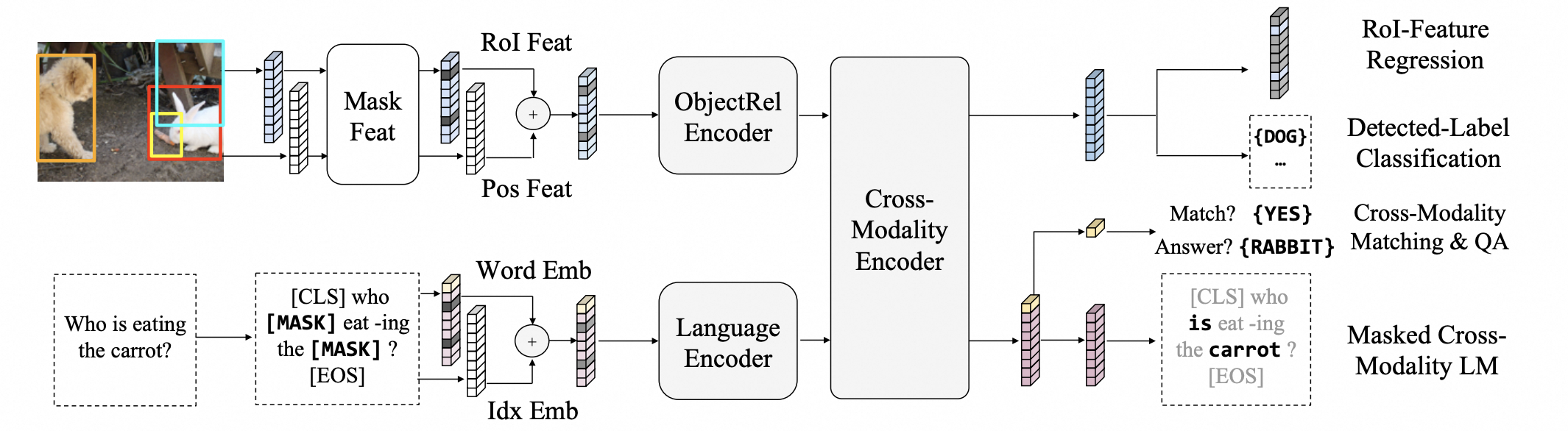
    • 各模态先独立编码,再在中间层交互(如多头注意力跨模态)
    • 例如LXMERT

  • 晚期融合(Late Fusion)
    • 各模态单独预测,最后以投票或加权平均融合结果
    • 例如 CLIP,图像和文本各自用独立编码器,映射到相同维度的嵌入空间,不在网络内部交互;最后通过相似度计算(如点积或余弦)来判断它们的关联性或并行输出多个任务的得分后再加权。
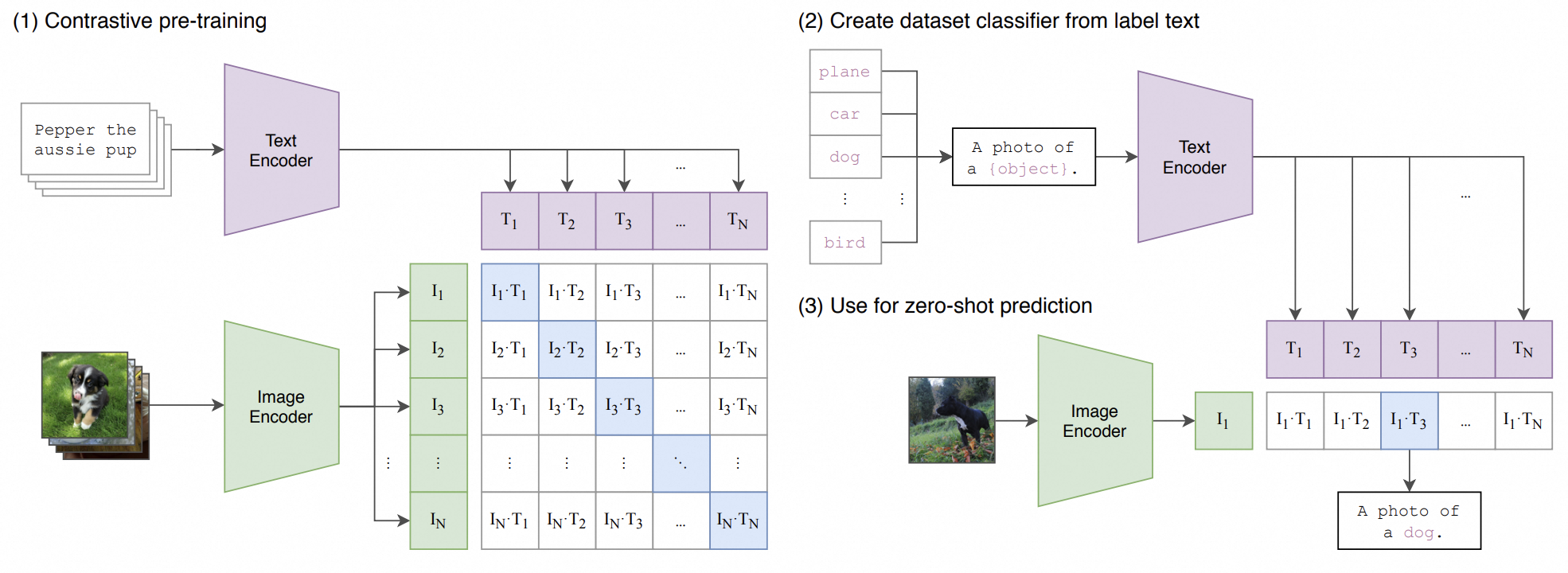
所以传统的SHAP没有办法解决

双模态下Shapley Value的推理

假定,图像特征为而文本特征为

对于图像特征,它的Shapley Value为

其中为权重。根据上面单模态SHAP的推论,不同模态下的权重之和应为1:

而图像模态的价值(预测值)应为:

与此同时根据刚刚的权重计算方式(组合方式),而不是像单模态那样直接把特征值拉通:

为什么需要+1,因为对于文本模态来说,图像模态可以看作是它的一个特征输入。

接着

如何使用SHAP来解释多模态

方案一

MM-SHAP: A performance-agnostic metric for measuring multimodal contributions in vision and language models & tasks [4]

  1. 对一条样本 (sentence,image_path)(\text{sentence},,\text{image_path})(sentence,image_path):
    1. 用 tokenizer 将句子转成 input_ids(长度为 L)。
    2. 用 FRCNN 抽取整张图像的 36 个 ROI 特征features(形状 [1,36,d][1,36,d][1,36,d])和对应的normalized_boxes
  2. 定义 custom_masker(mask, x)
    1. mask 是长度为 L+36L 的布尔向量:前 L位用来控制文本 token,后 36 位用来控制图像 patch。
  3. 定义 predict
  4. 初始化 SHAP Explainer
  5. 对单条测试样本计算 SHAP
# ---------- 1. 准备:预处理函数和模型加载 ----------

def preprocess(sentence, image_path):
# 文本编码
inputs = tokenizer(
sentence,
padding="max_length",
truncation=True,
max_length=MAX_LEN,
return_tensors="pt"
)
# 图像特征提取
imgs, sizes, scales = image_preprocess(image_path)
output = frcnn(imgs.cuda(), sizes, scales, return_tensors="pt")
feats = output["roi_features"] # [1, PATCH_NUM, feat_dim]
boxes = output["normalized_boxes"] # [1, PATCH_NUM, 4]
return inputs, feats, boxes

# ---------- 2. 定义 masker 与模型预测 ----------

def custom_masker(mask, x):
ids, feats = x # ids: [1, L], feats: [1, PATCH_NUM, D]
mask = torch.tensor(mask) # 长度 = L + PATCH_NUM

# 文本部分:mask 为 False 的位置用 PAD_ID
masked_ids = ids.clone()
masked_ids[~mask[:ids.shape[1]]] = PAD_ID

# 图像部分:mask 为 False 的 patch 特征置 0
masked_feats = feats.clone()
patch_mask = mask[ids.shape[1]:].bool() # [PATCH_NUM]
masked_feats[:, ~patch_mask, :] = 0.0

return masked_ids, masked_feats

def predict(x):
ids, feats = x
out = model(
input_ids=ids.cuda(),
attention_mask=torch.ones_like(ids).cuda(),
visual_feats=feats.cuda(),
visual_pos=boxes.repeat(ids.shape[0], 1, 1).cuda(),
token_type_ids=torch.zeros_like(ids).cuda(),
return_dict=True
)
probs = torch.softmax(out["cross_relationship_score"], dim=1)
return probs[:, 1].detach().cpu().numpy() # 每个样本的得分

# ---------- 3. 初始化 SHAP Explainer ----------

# 选一些 (sentence, image_path) 作为背景集,得 background_ids, background_feats
masker = shap.maskers.Partition(mask=custom_masker,
sample_data=(background_ids, background_feats))
explainer = shap.Explainer(predict, masker)

# ---------- 4. 对单个样本快速计算 SHAP 值 ----------

# 主循环中每次只需:
inputs, feats, boxes = preprocess(test_sentence, test_image_path)
x = (inputs.input_ids, feats) # [1, L], [1, PATCH_NUM, D]
shap_vals = explainer(x) # shap_vals.values 形状为 [1, L+PATCH_NUM]

# 解释结果:
# 文本 token 的 attribution = shap_vals.values[0][:L]
# 图像 patch 的 attribution = shap_vals.values[0][L:]

方案二

  1. 把“文本看作一个整体”,把它当作一个超级输入,对比各个图像 patch 的边际贡献。
  2. 同理对图像再进行一次
  3. 合并到每个子输入的最终归因

延伸

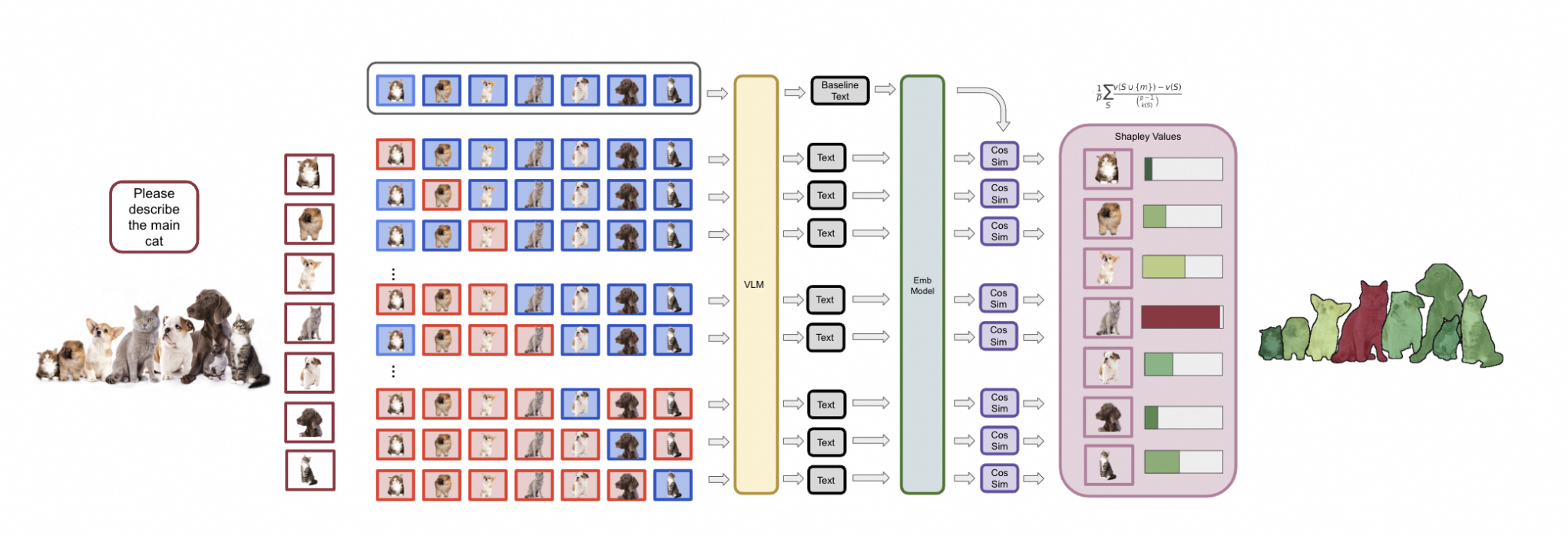
Attention, please! PixelSHAP reveals what vision-language models actually focus on. —— Roni Goldshmidt, 2025

  • 通过 Mask R-CNN、SAM(Segment Anything Model)等分割算法生成候选对象或区域;
  • 依次遮蔽单个对象(以基线贴图或随机噪声替换该区域),观察 VLM 重新生成文本的输出差异;
  • 根据 Shapley 公式集成这些差异,得到每个“图像对象”对文本输出的贡献评分。
References

[1]. Lipton, Z. C. (2016). The mythos of model interpretability. arXiv preprint arXiv:1606.03490. https://doi.org/10.48550/arXiv.1606.03490

[2]. For a proof of unique existence, see Ichiishi, Tatsuro (1983). Game Theory for Economic Analysis. New York: Academic Press. pp. 118–120. ISBN 0-12-370180-5.

[3]. Lundberg, S. M., & Lee, S.-I. (2017). A unified approach to interpreting model predictions. In I. Guyon et al. (Eds.), Advances in Neural Information Processing Systems, 30, 4765–4774. Curran Associates, Inc.

[4]. Parcalabescu, L., & Frank, A. (2023). MM-SHAP: A performance-agnostic metric for measuring multimodal contributions in vision and language models & tasks. In Proceedings of the 61st Annual Meeting of the Association for Computational Linguistics (ACL ’23) (pp. 4032–4059). Association for Computational Linguistics.

[5]. Lipovetsky, S., & Conklin, M. (2001). Analysis of regression in game theory approach. Applied Stochastic Models in Business and Industry, 17(4), 319–330.

[6]. Goldshmidt, R. (2025). Attention, Please! PixelSHAP Reveals What Vision-Language Models Actually Focus On. arXiv preprint arXiv:2503.06670.

[7]. Horovicz, M., & Goldshmidt, R. (2024, July 14). TokenSHAP: Interpreting large language models with Monte Carlo Shapley value estimation. arXiv preprint arXiv:2407.10114.

  • Title: Multimodal Interpretation
  • Author: Hao Feng
  • Created at : 2025-06-15 20:02:43
  • Updated at : 2025-08-14 09:22:27
  • Link: https://matt23-star.github.io/2025/06/Multimodal_Interpretation/
  • License: This work is licensed under CC BY-NC-SA 4.0.
Comments